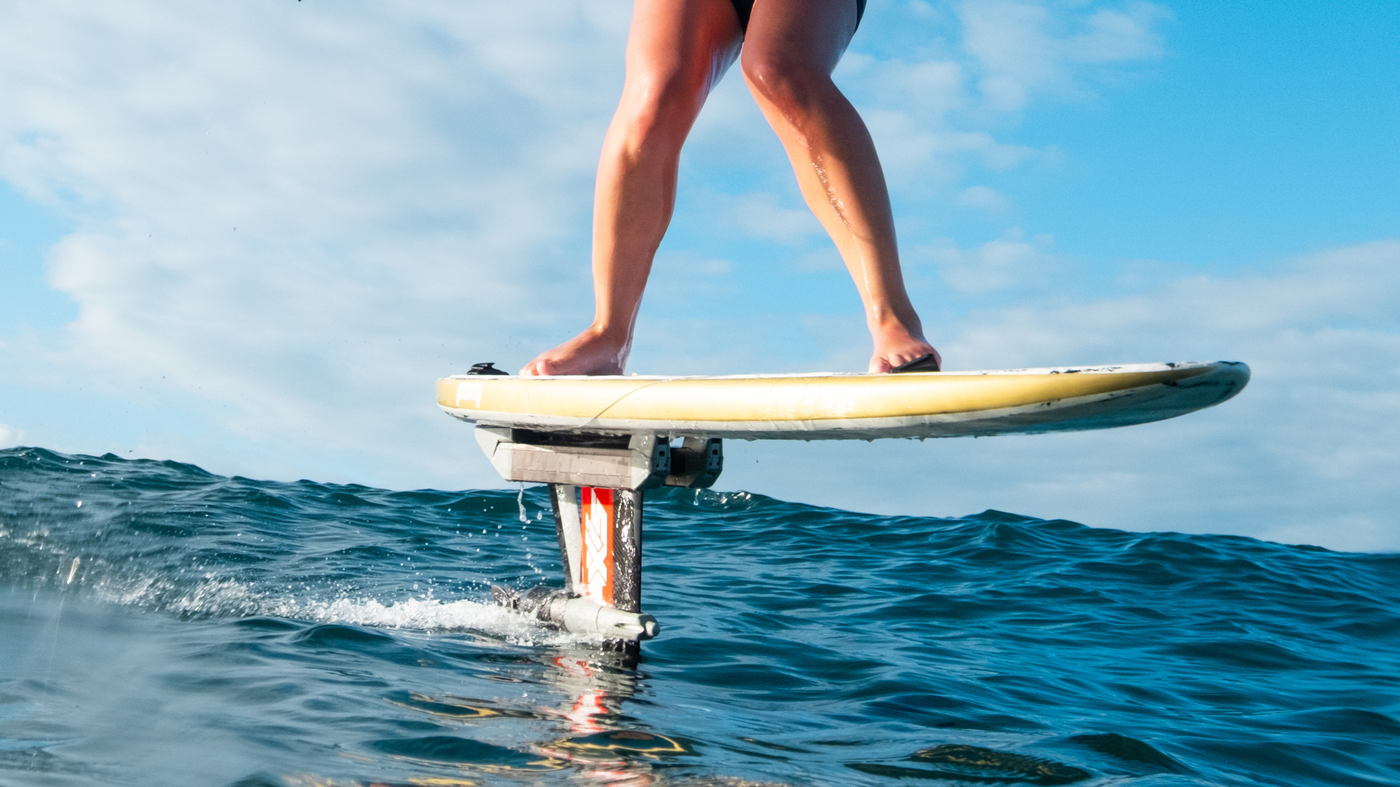
A foil assist does not do the same job for every rider. What it changes for a prone surfer is different from what it changes for a winger or a downwinder. Here is how an assist fits each discipline, and what to look for in a system depending on how you ride.
Prone
Prone foiling has the hardest entry of any discipline. You are paddling a low-volume board into a wave, then pumping to stay up. The two places riders lose sessions are the paddle-in and the link between waves.
An assist changes both. A pulse of thrust gets you onto foil without a perfect wave, and it carries you between sets so you are not burning out paddling back. For prone, the things that matter are strong takeoff thrust and a low-profile system that does not spoil the feel. Note that not every assist suits low-volume prone boards, so check board compatibility before you buy.
Wing
Wingers live and die by wind. When it drops, the session is over. An assist keeps you on foil through the lulls and gets you up before the wind fills in, which turns marginal wind days into rideable ones.
Wingers rarely need long, continuous power. They need a clean burst to get up and short top-ups through holes in the wind. Thrust for the takeoff matters more than huge runtime here.
Downwind
Downwind is the discipline where an assist arguably changes the most. Catching bumps and linking them is brutally hard, and a missed connection means a long pump or a swim. Thrust to get up and bridge gaps between bumps lets you ride lines you could not otherwise hold, and it makes the learning curve far less punishing.
Downwinders benefit from strong thrust and enough capacity to cover a long run.
FoilBoost is built for prone, wing and downwind foilers. Its 33 kg of peak thrust covers the hardest part of all three disciplines, the takeoff, with margin for heavier riders and weaker conditions. Its 432 Wh battery gives the capacity downwinders and session-stackers want. One system, sized for the moments each discipline finds hardest.