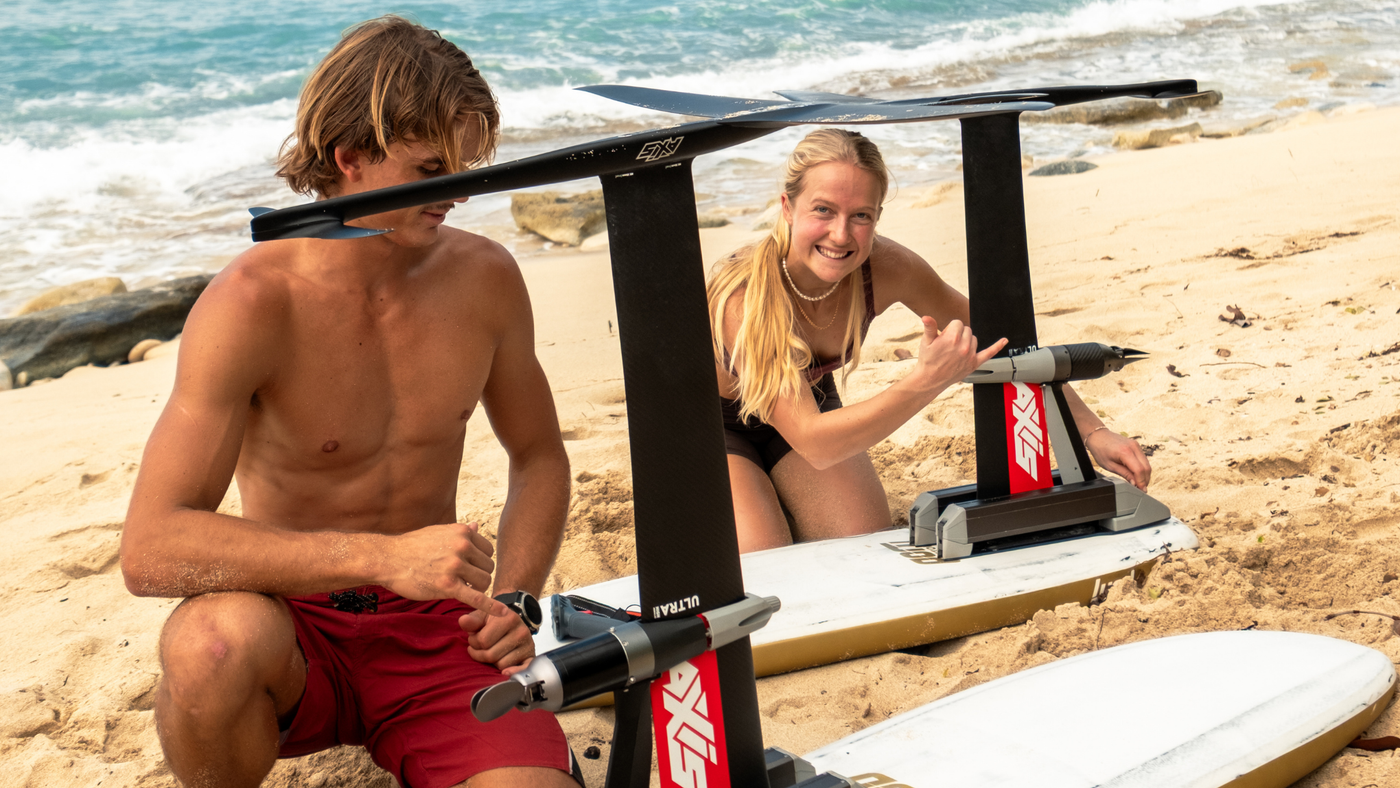
The last question most riders ask before ordering a FoilBoost is also the most practical one: will it actually fit my setup? The answer is more precise than most foil assist buying advice suggests, because FoilBoost compatibility is decided by one measurement, your mast chord, not by your board model or brand.
The measurement that matters: mast chord
The mast chord is the front-to-back width of your mast, measured in millimetres at the height where the unit clamps. Across its pad and bolt combinations, FoilBoost covers chords from 96 to 144 mm. Two things to keep in mind alongside that range. First, the manufacturer states these figures come from internal testing and may vary with mast design, so treat them as a strong guide rather than a guarantee. Second, the mast clamp is mandatory: using the unit without it may damage the product.
The compatibility table
The range you get depends on which pads and bolts you use:
| Pad set | With M5x25 bolts | With M5x45 bolts |
|---|---|---|
| Standard pads | 106 to 126 mm | 106 to 144 mm |
| Mixed pads | 101 to 119 mm | 101 to 139 mm |
| Extended pads | 96 to 114 mm | 96 to 134 mm |
Read it from your measurement: a 110 mm chord fits comfortably on several combinations, a 96 mm chord needs the extended pads, and a 144 mm chord needs standard pads on the longer bolts. If your measurement sits at the edge of a band, mention it when you order the FoilBoost kit and we will confirm the right combination before anything ships.
Notice what is absent from that table: board brands, board models, foil brands. The clamp holds the mast, so the same unit that serves one rider's prone board serves another rider's downwind setup, provided the chord is in range. That is why the fitment conversation on the beach is short, and why second-hand setup changes rarely strand the unit.

How to measure your mast
Use a ruler or calipers on the mast itself, not the spec sheet, because published chord figures sometimes describe a different point on a tapered mast than the clamp height. Measure front edge to back edge, in millimetres, at the height where the pod will sit. It takes a minute and removes all the guesswork from the order.
If you ride more than one mast, measure each of them. Many riders run different masts for prone and wing days, and a combination that fits one may need different pads on the other. Knowing both numbers up front means the pads and bolts that arrive in the box cover your whole quiver, not just the mast you happened to measure first. And if a future mast purchase is on your mind, its chord is now one of the numbers worth checking before you buy it.
Boards and disciplines
Because the mount is chord-based, the board itself is rarely the constraint. The FoilBoost kit uses a 2-way design that helps you take off easier and ride longer on prone, wing and downwind, and at 5.7 kg with both batteries the system stays manageable to carry and to swim with. It is built for riders who already foil in those disciplines; it is an addition to an existing quiver, not a way into foiling.

The kit, the spares and the honest handoff
The kit ships with two batteries, rated together for up to 40 minutes of runtime, with charging both packs in parallel taking around two and a half hours. The system delivers 33 kg of thrust, which our thrust guide puts in context against what each discipline actually needs. A spare FoilBoost battery extends a session day without waiting on a charge. For transport, the same bags that serve our eFoil riders work here: a mast bag for the foil hardware and a travel board bag for the deck. Browse the full foil assist range to see the kit and accessories together.
And the honest segmentation line: if you do not already ride a prone, wing or downwind foil, FoilBoost is not the product to start with. It assists riders who foil; it does not teach foiling. Our foil assist vs eFoil guide explains which path fits which rider.
Related reading: how to choose a foil assist system, the FoilBoost installation guide, and FoilBoost battery, range and charging.